While the future impact of COVID-19 in New Brunswick remains unknown, we can look for lessons in history. A little more than 100 years ago, the 1918 flu epidemic catalyzed the NB Public Health System, leading to fewer casualties than other places. Gerry McAlister describes the great influenza epidemic of a century ago, based on research published by Jane E. Jenkins.
***
The great influenza epidemic of 1918-1919 saw more than 35,000 cases and 1,400 deaths in New Brunswick. A few months prior to the outbreak, the province appointed its first Minister for Health, a first in not only Canada but also the British Empire. It proved to be a fateful development.
Prior to 1918, disease outbreaks and public health in general in the province had been dealt with in a haphazard, reactive manner. There had been various Health Acts in the 19th century in 1833, 1877, 1898 and finally in 1903, when municipalities were compelled to finance their own health boards. However while intentions were good, progress was slow and finance always an issue. Lack of strong central control, as in a Department of Health, was the real problem.
The growing progressive reform movement of the early 20th century allied to the pioneering work of individual doctors saw a gradual change of attitude.
The new Department of Health initially came in for scathing criticism from opponents of public health measures. This soon faded as the epidemic spread. And by the time it had receded early in 1919 the province’s death rate of 4 per 1,000 was, after Ontario, the second lowest in Canada. The concept of preventative public health measures was here to stay.
The 1918 influenza epidemic was almost unique in its severity. Between 50 and 100 million people died globally, rivaling the 14th century Black Death in Europe. Ironically, like tuberculosis, it often targeted the very healthiest of active young people. Feverish aches, frantically gasping for air, coughing up blood, the victim could die within a day or two.
In Canada, 50,000 people of a population of eight million died. Soldiers arriving in Quebec after The Great War brought it in and it soon spread across the country. Saskatchewan had a death rate of 10.1 per 1000, Alberta, 11.5. However the worst rate by far was among the 61,000 troops in military camps across the country where the mortality rates ranged from 15% to 75%. This puts the New Brunswick rate of 0.4% into perspective.
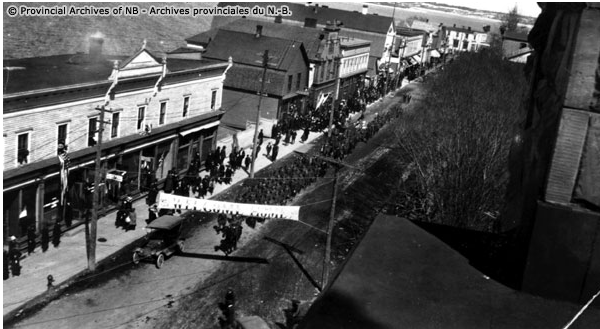
The epidemic swept into the province in October. The individual tragedies quickly mounted. Three Bouctouche brothers on home leave from Sussex military camp caught the disease and all three died within a day, their mother on the following day. Fredericton saw 1,000 cases out of a population of 7,500. In Grand Falls, 75 had died by the end of the month.
The new Department of Health consisted of Dr. William F. Roberts, the Minister and the Chief Medical Officer, Dr. George C. Melvin. According to Roberts, the epidemic was like a fire, ‘a fire greater and more deadly than any experience in The Great War.’ Both of these men favoured central control of public health matters in areas as diverse as food inspection, slaughterhouse control, free venereal and tuberculosis clinics, pasteurization of milk and vaccination of school children. They were the right people in the right place for the storm that was coming.
They had a strong sense of social responsibility. They believed that social ills could only be alleviated through public health measures.
Roberts ran for a Liberal seat in the legislature in 1917 on a platform of establishing a provincial department of health. Once elected he put his Bill to the Liberal caucus which was lukewarm in support and then to the legislature where there was fierce opposition. He had, for example to return to caucus three times before it was accepted. Nor did he depend solely on health or social or humanitarian grounds in his persuading. Good health is good for business was one of this themes. In the end he had to offer to serve without a ministerial salary as a final carrot before the Bill was narrowly adopted on April 26, 1918.
The ‘baptism of fire’ was not long in coming. With the return of the troops, the disease spread rapidly and the death toll rose. By mid-October, thousands lay sick and dying in New Brunswick.
Roberts’ response was swift: he shut down the province. On October 9 he ordered all schools, theatres and churches closed. All public gatherings and meetings were prohibited. Streetcar numbers were restricted. Trains were fumigated. Caskets of the dead were ordered closed and only family members were allowed to attend funerals. Using telephone and telegram, a province wide strategy was coordinated. Nursing, Red Cross and other voluntary organizations were brought into play. In all of this, Roberts stood firm and refused requests from churches and other bodies for exceptions to be made.
The epidemic peaked in November 1918 and was fading by the end of January 1919. The new Department of Health was undoubtedly a key factor here. Praise was showered on it and on Roberts. Previous opponents saw the necessity of strong central public health control. Within a year further improvements in public health had been achieved. Vaccination of schoolchildren, control of two smallpox outbreaks, free venereal and tuberculosis clinics, pre-natal and pre-school clinics. The pasteurization of milk was made mandatory.
We owe Dr. Roberts (1869-1938) a debt of gratitude.
This story is based on an article published in 2007 by Jane E. Jenkins: Baptism of Fire: New Brunswick’s Public Health Movement and the 1918 Influenza Epidemic.
Gerry McAlister writes for the NB Media Co-op and delivers The Brief in Fredericton. He earned a Master’s degree in Modern Irish History from Dublin City University with a thesis on the anti-tuberculosis campaign of the Women’s National Health Association, 1907-1911.