
Une version française suit le texte anglais.
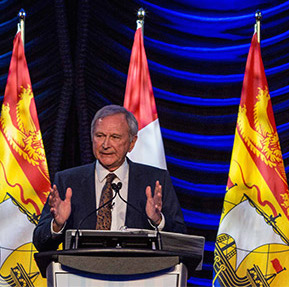
In his state of the province address, Premier Blaine Higgs took up the issue of social assistance, briefly mentioned in his electoral platform and in his throne speech. Through this speech, we can better understand his intentions.
Higgs reiterated the need to reform social assistance, but with no mention of the poverty reduction plan, even though it was part of his throne speech. He is more concerned about the labour shortage in certain sectors of the economy and doesn’t mention providing learning opportunities for people on social assistance, as mentioned in his electoral platform. No reference is made about launching a discussion on models to enable more short-term help to recent social assistance recipients, as mentioned in the throne speech. According to Higgs, we must find ways to get social assistance recipients back to work. To do so, his government aims to take care of transportation, child care and even housing.
First of all, the NB Common Front for Social Justice is certainly not against the government helping citizens on social assistance find employment. This is already taking place through different education programs, workforce re-entry, an extension of the health card for three years, as well as helping with child care and housing costs, etc. Enhancing these programs can only prove positive.
Higgs seems to think that individuals can overcome poverty automatically by getting a job. This is not necessarily the case. In fact, if individuals have well-paying jobs, their salary will help them live above the poverty line and meet their needs; when they have a minimum wage job, they cannot live adequately. The Common Front for Social Justice has recently published a study on net income and expenditures in four categories of minimum wage workers; at the end of the year, they all had a deficit based on their expenditures. Therefore, a job will not guarantee a life free from poverty.
The great majority of social assistance recipients are not able to work, whether because they lack qualifications or education, are critically ill, or have physical or mental problems, etc. They are permanently unemployable, and as a society, we must accept this situation and stop harassing them.
Higgs is saying that we have become too tolerant of citizens who depend on social assistance over several years to survive. For him, we should now scrutinize the lives of these recipients to find out how long they have been on social assistance and become intolerant towards them, according to an arbitrary measure -let’s say a minimum of two to five years. It is shameful to want to stir up intolerance towards citizens who unfortunately have to live in poverty and who are at the mercy of our social net!
Another questionable statement from the speech was to state that the government is giving too much to certain recipients, and that it prevents us from helping those who absolutely cannot work because of a disability. How should we take this statement? Should we now slash the incomes in one category of recipients and transfer this money to another category? Instead of addressing the problem, Higgs wants to divide recipients into categories, stipulating that one is more deserving than another.
For your information, Mr. Premier, almost one-third of all social assistance recipients have not had an increase in their basic rate since 2010 and the others, since 2014. They have all lost buying power because of inflation and the increase in prices for basic needs.
As it stands, thousands of people in New Brunswick are already subjected to constant monitoring by the Department.
In actual fact, all are already victims of prejudiced attitudes in the general population.
Higgs says he wants to reform social assistance but his speech is not reassuring. What we need in New Brunswick is a frank and open discussion on poverty and on ways to reduce it. The poverty reduction plan for the next five year review process is set to begin, and we believe this to be an ideal opportunity to lead a broad reflection on possible tools and actions to be taken to reduce poverty and the stigma surrounding it.
Pauline Richard is co-chair of the New Brunswick Common Front for Social Justice.
Les propositions de M. Higgs ne réduiront pas la pauvreté
Dans son discours sur l’état de la province, le premier ministre Blaine Higgs a repris le thème de l’assistance sociale qu’il avait déjà mentionné brièvement dans sa plateforme électorale et dans son discours du trône. Avec ce discours, nous commençons à mieux comprendre ses intentions.
Dans ce discours sur l’état de la province, M. Higgs revient sur la nécessité de réformer l’aide sociale, mais sans mention du plan de réduction de la pauvreté qui était pourtant présent lors de son discours du trône. Il se préoccupe plutôt du manque de main-d’oeuvre dans certains secteurs de l’économie. Il n’y a aucune mention de faciliter l’accès à la formation pour les personnes sur l’assistance sociale tel que mentionné dans la plateforme électorale. Il n’y a aucune référence quant au lancement d’une discussion sur les modèles pouvant fournir davantage d’aide à court terme aux récents bénéficiaires de l’aide sociale comme mentionné dans le discours du trône. Pour Blaine Higgs, il faut trouver les moyens pour que les bénéficiaires de l’aide sociale retournent au travail. Pour ce faire, son gouvernement compte aider ceux-ci en s’occupant du transport, de la garderie et même du logement.
Tout d’abord, il est certain que nous ne sommes pas contre le fait que le gouvernement doive aider les citoyens qui sont sur l’aide sociale à se trouver un emploi. Il le fait déjà par l’entremise de différents programmes d’éducation, de réinsertion au travail, de garder la carte médicale pour trois ans, d’aider avec les coûts de garderie et de logement, etc. Si M. Higgs désire ces programmes bonifiés, cela ne peut être que positif.
M. Higgs semble croire que l’acquisition d’un emploi permet automatiquement à un individu de sortir de la pauvreté. Ce n’est pas nécessairement le cas. En effet, si un individu a un emploi bien rémunéré, son salaire lui permet d’être au-dessus du seuil de pauvreté et de répondre à ses besoins, mais lorsqu’il a un emploi au salaire minimum, il ne peut pas vivre adéquatement. Le Front commun pour la justice sociale a publié une étude sur le revenu net et les dépenses de quatre catégories de travailleurs au salaire minimum; à la fin de l’année, tous avaient un déficit par rapport à leurs dépenses annuelles. Donc un emploi ne garantit pas une vie hors de la pauvreté.
En réalité, la grande majorité des bénéficiaires de l’aide sociale ne sont pas aptes au travail, que ce soit en raison d’un manque de qualifications, d’éducation, de maladie grave, de problèmes physiques ou mentaux, etc. Ils et elles ne seront jamais employables et nous devons, comme société, l’accepter une fois pour toutes et cesser de les harceler.
D’autre part, M. Higgs suggère que nous sommes devenus trop tolérants envers les citoyens qui dépendent de l’aide sociale pendant plusieurs années pour survivre. Il faudrait maintenant scruter la vie de ces bénéficiaires pour savoir depuis combien de temps ils sont sur l’aide sociale et selon une mesure arbitraire, disons un minimum de deux à cinq années, devenir intolérant envers eux. Vouloir mousser l’intolérance envers des citoyens à part entière qui ont le malheur de vivre dans la pauvreté et d’être à la merci de notre filet de sécurité sociale est honteux!
Une autre affirmation du discours qui nous fait sourciller est de dire qu’on en donne trop a certains bénéficiaires, et que cela nous empêche d’an aider d’autres, ceux qui ne peuvent absolument pas travailler à cause d’un handicap. Comment faut-il prendre cette affirmation ?
Qu’on devrait maintenant couper les revenus d’une catégorie de bénéficiaires pour transférer cet argent vers une autre catégorie? Au lieu d’aborder le problème, M. Higgs diviserait les différentes catégories de bénéficiaires stipulant qu’une catégorie est plus méritante qu’une autre. C’est honteux de tenir un tel discours de la part de notre premier ministre.
Pour votre information M. le premier ministre, près d’un tiers de tous les bénéficiaires de l’aide sociale n’ont pas reçu d’augmentation de leur taux de base depuis 2010 et les autres depuis 2014. Tous ont perdu une partie importante de leur pouvoir d’achat à cause de l’inflation et de l’augmentation des prix pour les besoins de base.
La réalité est que des milliers d’hommes, de femmes et d’enfants sont déjà soumis constamment a de la surveillance de la part du ministère.
La réalité est que tous et toutes sont victimes des préjugés de l’ensemble de la population.
M. Higgs dit vouloir réformer l’aide sociale, mais son discours ne nous rassure pas. Ce dont nous avons besoin au Nouveau-Brunswick, c’est une discussion franche et ouverte sur la pauvreté et sur les façons de la réduire. Le processus de révision du plan de pauvreté pour les prochaines cinq années va s’amorcer et nous croyons que c’est l’occasion idéale pour mener une large réflexion sur les outils et actions nécessaires pour réduire la pauvreté et enrayer les préjugés qui y sont rattachés.
Pauline Richard, Coprésidente, Front commun pour la justice sociale
=
![Tertulia – Mary McCarthy-Brandt on New Brunswick’s first Black lawyer Abraham Beverley Walker [video]](https://newnbmedia.mydev.ca/wp-content/uploads/2021/02/Mary-McCarthy-Brandt-350x250.png)


