
Is New Brunswick’s provincial government deliberately hiding the truth from itself about cancer, cancer ‘hotspots,’ and the connection between some cancers and the workplace in the province?
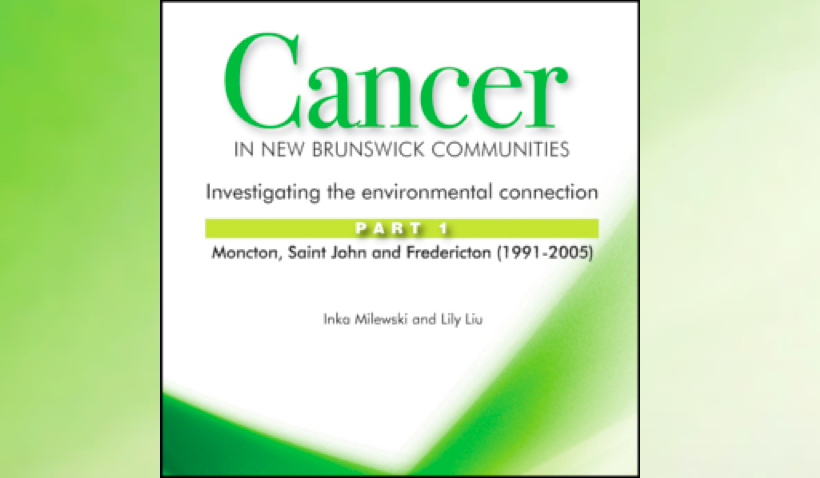
Six years ago, a major study, “Cancer in New Brunswick Communities: Investigating the environmental connection” by Inka Milewski and Lily Liu, found that the provincial practice of “reporting cancer incidence rates by large geographic areas obscures important information about the health of New Brunswickers at the community level.”
That 2009 study, published by the Conservation Council of New Brunswick, also found that “community-level data on cancer risk factors (e.g. behavior/lifestyle, occupation and environmental quality) are virtually non-existent.” Further, it noted that there were no peer-reviewed scientific studies on “cancer risks associated with various occupations in New Brunswick” and that “long-term data on community-level exposure to environmental and industrial pollutants are also non-existent.”
Environmental, rather than genetic, factors are now known to be the primary cause of various cancers. The Milewski-Liu study notes that New Brunswick’s strategy for dealing with cancer “fails to identify cancers hotspots and their risk factors in communities” and delays “the development and implementation of risk intervention programs for those [hotspot] communities.”
It called on the Province of New Brunswick to conduct a study to examine the relationship between some cancers and jobs or occupations in the province, but six years later, nothing has been done.
Milewski and Liu studied 14 communities in New Brunswick and identified several cancer hotspots, that is, communities that “had cancer rates that were double the provincial rates” for cancers like pancreatic cancer among males in Caraquet, non-Hodgkin’s lymphoma among males in Dalhousie, and lung and colorectal cancers among females in Minto.”
They noted that “the rate of ovarian cancer in Dalhousie was triple the reported provincial rate for this cancer” and recommended “more detailed, community-focused epidemiological studies of cancer and other chronic disease rates.”
The provincial government and its Department of Health, however, continue to ignore cancer hotspots and still collect data by large geographic region which actually hinders the identification of cancer hotspots.
‘Elephant in the living room’
Successive provincial governments have ignored the connection between toxic chemicals used in forest-spraying programs and other industrial applications.
For example, in 1982, a provincial task force examined the relationship between aerial spraying of fenitrothion in New Brunswick and cancer. It determined that, between 1972 and 1981, Northumberland county had the highest frequency of exposure to fenitrothion followed by Victoria, Madawaska and Restigouche counties.
In 1976 alone, an estimated 800 metric tonnes of fenitrothion was used, and the (Spitzer) task force concluded that stomach, uterine and lymphatic system (other than leukemia) cancers were highest in counties with above average spraying of forest pesticides (Northumberland, Victoria, and Restigouche counties).
The Milewski-Liu study notes that “when the task force compared cancer rates between New Brunswick and Nova Scotia–where aerial spraying was not done at the time, cancer incidence rates (1969-78) were significantly higher in New Brunswick for 11 cancers in males and 11 other cancers in females. Between 1952 and 1990, 100,000 metric tonnes of DDT and fenitrothion were applied to New Brunswick’s forests – that’s about 2,600 metric tonnes a year.
None of this, however, has been enough to convince either Liberal or Conservative provincial governments of the need to be pro-active in identifying and responding to cancer hotspots or studying the linkage between specific cancers and certain jobs. Yet, year after year, successive cabinet ministers and their officials repeat their mantra of forestry spraying being safe.
So, six years after Milewski and Liu established the existence of cancer hotspots in New Brunswick, many very troubling life and death questions go unanswered, including, but not limited to:
• Why are ovarian cancer rates in Dalhousie more than 200% higher than the provincial rate?
• Why do men and women in Edmundston have high rates of thyroid cancer?
• Why do men in Belledune have high rates of prostate and kidney cancers?
• Why do women in the Base Gagetown and Upper Miramichi areas have high rates of brain cancer?
• Why do women in Dalhousie have high rates of kidney, ovarian, bladder and pancreatic cancers
and men have high rates of bladder, non-Hodgkin’s lymphoma and colorectal cancer?
• Why do men and women in the Minto area have high rates of lung, colorectal and bladder cancers?
Why indeed?
Dallas McQuarrie is a NB Media Co-op news writer and a former journalist with CBC.

![Bob Bancroft: Where have all the good forests gone? [video]](https://newnbmedia.mydev.ca/wp-content/uploads/2020/10/clearcut2-js-350x250.jpg)


