
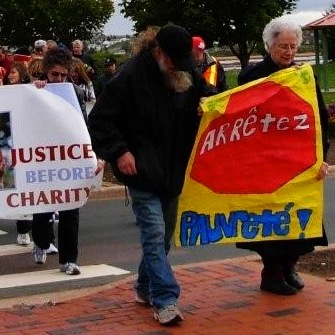
Fredericton – The NDP and anti-poverty groups clashed in September over how to reduce poverty in the lead up to the provincial election in New Brunswick. The NDP said it would pilot Social Impact Bonds (SIBs) as an aggressive way to tackle poverty in the province.
Announcing the poverty reduction plank of his party’s platform in Saint John on Sept. 2nd, NDP leader Dominic Cardy explained that the SIB pilot program would fight poverty and fuel sustainability of community organizations by allowing them to make bids on services. Cardy further emphasized that SIBs are a way for community groups to participate in solving problems in their own backyards.
Anti-poverty advocates such as the Common Front for Social Justice do not support the use of SIBs as a way of reducing poverty and feel that increasing the minimum wage and social assistance rates would do more to alleviate poverty.
The Common Front also advocate modernizing the province’s Drug plan so medications are more accessible, implementing an affordable child care program, investing in public housing, restoring cuts to Employment Insurance (EI), stopping clawbacks to pensions and implementing pay equity in the public and private sectors.
“‘An aggressive poverty reduction strategy would have something for the 40,000 people in this province who have to depend on social assistance and food banks to survive. The NDP strategy does not address basic social assistance rates, which are some of the lowest in the country, or what is needed to help those who are employable return to work,” argues Pauline Richard, co-chair of the Common Front for Social Justice, New Brunswick’s largest anti-poverty group.
One in seven New Brunswickers live below the poverty line. Sixty food banks in New Brunswick are feeding close to 20,000 women, men and children each month. Two-thirds of food bank users receive social assistance, according to Richard.
Graham Cox, a researcher with CUPE, Canada’s largest public sector labour union, calls SIBS a disruptive form of social service privatization.
“Social impact bonds pose a major risk to the preservation of valuable public services… Unions and non-profit organizations involved in the delivery of services to people should oppose them,” argues Cox.
The Common Front concurs that SIBs are a way of reducing the responsibility of government to deliver social services to citizens by turning it over to community groups or to the private sector. The coalition argues that donors will want a return on their investment, so they will fund projects or services that are more easy to administer and measure.
Investors having more influence than elected representatives over social programs like illiteracy, child protection, and support for released prisoners concern the Common Front.
The government of British Columbia is passing several laws that would introduce SIBs into the public sector. SIBs have been implemented in the US, UK, Australia and New Zealand.
Finance for Good is a Canadian non-government organization behind the use of SIBs. They argue that SIBs allow the government to pay only if a contract becomes successful, therefore saving the government money in the case of failed social programs. According to Finance for Good, service providers will also benefit because they will continue to have long-term funding if they become successful.
Jean-Claude Basque, provincial coordinator of the Common Front, worries foremost about accessibility and affordability for service users.
“Are those who need the services the most going to be able to access these services? Where would they put these services? My guess is in urban areas. This could be a major problem for people working for minimum wage. SIBs are about providing cheaper services. If a larger company can provide a cheaper service, smaller companies will feel pressure to compete and this could impact salaries, lead to job losses and cuts to benefits that workers are owed,” argues Basque.
Cardy was unavailable for a response regarding these criticisms by press time.
Matt Mosher is a social work student at St. Thomas University interning with the NB Media Co-op
![Tertulia – Mary McCarthy-Brandt on New Brunswick’s first Black lawyer Abraham Beverley Walker [video]](https://newnbmedia.mydev.ca/wp-content/uploads/2021/02/Mary-McCarthy-Brandt-350x250.png)


