There is no way around it. A village without water will die.
Several years ago, our village dug 35 wells before finding two that would give us reliable water. Good water is hard to find in hydrocarbon-rich Albert County.
Now, we understand Hillsborough sits on a significant oil reservoir. Below the oil lies what a Corridor Resources spokesman calls “the largest known shale gas play in North America by an order of magnitude.”
It is called the Frederick Brook member, a shale play that extends from Memramcook, Hillsborough and Stoney Creek, to Elgin and Sussex (the leases are split between Contact Exploration, Petroworth and Corridor Resources).
“In the shale gas world, I’m not aware of anything that comes remotely close to the Frederick Brook Shale, and that’s because of its thickness,” says Corridor’s geologist.
Well pads already surround Hillsborough on three sides. Some are for oil. Some are for the natural gas below the oil. The process for extraction is largely the same.
The oil and gas lies within what geologists call a ‘complex’ area. The faults running through the layers of rock look like a three-dimensional tic-tac-toe. In the midst of this tic-tac-toe board, lies oil well ‘B55.’ It is situated about 1,500m or less from our municipal wells and close to private wells. B55 is a little over 1000m deep. Our village water well taps into the aquifer at 200m.
But don’t worry, says our government. In assessing the lay of the land, they have determined if a spill or other accident occurs, the natural flow of contaminants would be away from the village water wells and toward the river.
Really? Well, that also means spills would flow toward the homes with private water wells.
Understand this: I am no eco-terrorist or fear-mongerer. I do not insult or intimidate people who disagree with my viewpoint. I’m all for employment and prosperity in New Brunswick. Who isn’t?
I’m simply a homeowner and self-employed writer. My work ebbs and flows like the Fundy tide. I have no pension. My home is my safety net.
I live and work here in Hillsborough. We have wetlands and wildlife. We’re friendly folk who hike and bike the village trails, and appreciate fresh air, and a dark sky filled with stars. We have easy access to forests, lakes and streams. You get the picture.
So all this concerns me. Deeply. It concerns my neighbours. It concerns our village council and our local businesses. It also concerns doctors, geologists, scientists, engineers, economists, lawyers, and everyday people all over this province who have spent thousands of unpaid hours researching independent studies on the issue and giving people the information our government should be providing.
You might think that Hillsborough would have a soft spot for oil and gas exploration. We lie a few minutes from Stoney Creek, New Brunswick’s first developed oilfield. But you’d be wrong. I’ve toured the Stoney Creek oilfield. I know people who experience gas fumes and headaches from wells that currently operate in that area.
Many private wells in Stoney Creek have bad water quality and quantity. Is this due to 100 years of oil drilling or because of natural contaminants? We don’t know. No one mapped aquifers or tested water back then. No one is mapping our aquifers now.
Proponents of industry say we do things better here in Canada. That we have more ‘stringent and rigorous rules’. Rules that call for setback of 250m from private homes and 500m from schools, yet a long-term health study from the University of Colorado found highly elevated risks for cancer and other diseases for those living within 750m of a gas well and a Duke University study found highly increased risk of methane contamination of water wells within 1km of gas wells.
Stringent? Rigorous?
I’ve toured Penobsquis too, and smelled fumes from the gas wells on the flood plains of the Kennebecasis River.

I’ve seen how close well pads are to each other and homes. I’ve talked with residents who spent $15,000 and 25,000 volunteer hours trying to resolve their water losses. Alone.
Ask them about the risks vs benefits. Ask them if the loss of water to 60 families was worth the 6 jobs the industry created.
And so I wonder what Hillsborough will look and smell like—what life will be like—if oil and gas development continues in Albert County.
The trouble is, our pastoral village lies in the crosshairs of an industry with a noxious reputation. And will be subjected to a process that no one can prove is safe.
In spring 2011 our province gave Contact Exploration the approval to bring into production up to 39 existing oil and gas wells in the Stoney Creek–Hillsborough area. Prior to releasing their new rules, the government approved the drilling of four more wells.
We have many unknowns: complex geology, a precarious water supply, the scale of future oil and gas development. Then there are the knowns: noise, pollution, truck traffic. The impact on property values, human health and well-being.
Recent research on the effects of shale gas development on property values shows that not only are properties devalued in the near vicinity of development, but also in neighbouring communities.
Our own Chief Medical Officer, Dr. Eilish Cleary, expressed concerns for people living in close proximity to gas and oil development, and last fall made 30 recommendations necessary to prevent or mitigate impact on public health. Our government, however, has not yet issued a formal response or proposed action plan for these recommendations, and, in fact, only released it after public pressure to do so.
And then there is the economic well-being. We’re told New Brunswick stands to gain hundreds of jobs and billions in revenues from shale gas development. Perhaps you are like me and find this rather vague and loosey-goosey.
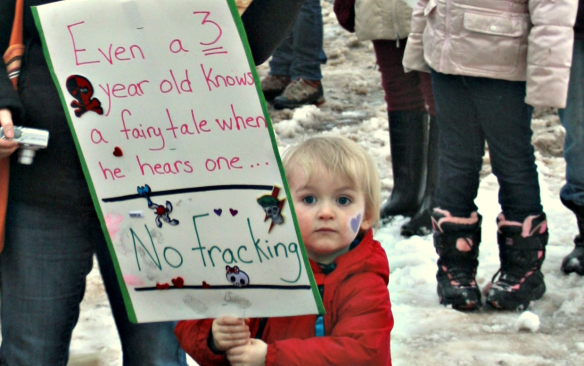
A Cornell University team recently studied Pennsylvanian towns affected by oil and gas developments. Their report found that jobs were short-term and low-paying, when the drill teams moved on, those towns are economically worse off than before. I have yet to find a Happy Frack Town.
So, perhaps you might excuse me, instead of accuse me, for opposing oil and gas development in my area and in my province. Perhaps, instead of thinking of me a protestor, you may think of me as a protector.
Because it is not just my backyard. This is a small province. It is actually your backyard too.
Originally published on the Protect Albert County: Water and Environmental Protection for Albert County blog.