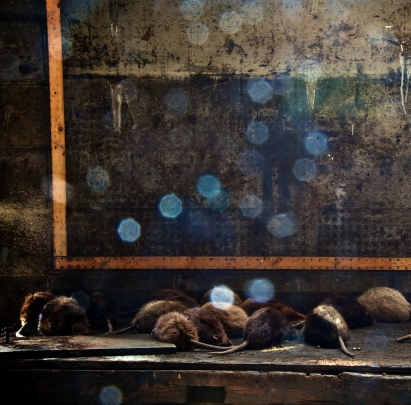
 Fredericton-based artist Janice Wright Cheney pursues discomfort, delighting in creatures usually considered repulsive, including maggots, beetles, and fleas.
In her recent work entitled The Cellar, on exhibit at the Beaverbrook Gallery in Fredericton from Oct. 25th to Feb. 10th, 2013, she turns toward the Norway rat (Rattus norvegicus), a species of rodent linked with filth, poverty, and the spread of such diseases as the plague.
Wright Cheney lovingly produces hundreds of life-sized rat bodies in sumptuous fur, reshaping the once-fashionable coats worn by middle and upper-class women into art installations. Creating models of various colours and textures, she places them behind old wooden doors, inside cages, or piled up in the corner of a room. This replication of furry rat-objects mimics the reproductive capacity of the rodents: an average female gives birth about eight times per year, producing some seven to eleven young per litter. Since breeding can begin at three months of age, the potential expansion of the rat population is astonishing. Yet for much of western history, people have tried to limit this growth rather than celebrate it.
In cold climates Norway rats are dependent on humans, and cannot survive in sparsely populated areas that lack adequate shelter. In many ways humans are equally dependent on rats. Norway rats have historically replaced humans, or at least stood in for them temporarily, in medical and scientific experiments.
In 1961, the French even launched the first rat into space to test the survivability of human space travel. The miniature spacecraft is currently on display, complete with a stuffed rat passenger, at the Musée du service de santé des armées in Paris. At the same time, rats are regularly personified as sneaky and deliberately destructive, whereas people denounced as “rats” are lawbreaking traitors, liars, and thieves.
Various literary studies address the contradictory status of rats in the western world—most recently the book by Robert Sullivan, in which he describes the year and a half he spent observing and researching rats in New York City (Rats: Observations of the History and Habitat of the City’s Most Unwanted Inhabitants, 2005). Although Sullivan openly admires the survival skills of rats, and in spite of the appealing cartoon rats featured in Disney’s 2007 film Ratatouille, many western people continue to find rats disgusting.
Wright Cheney asks us both to reflect on and confront this response. She creates rat bodies that are best described as engaging, a term that can act as an adjective as well as a verb. An engaging object is charming and amusing, whereas the infinitive form “to engage” means to fit into place, hold, or absorb. Western scientific practice controls, studies, and classifies rats.
Pest management agencies track, trap, and destroy rats, especially in the province of Alberta. Since 1950 the Alberta government has funded a rat-control program, complete with pest officers who patrol the eastern border, exterminating rats attempting to emigrate from Saskatchewan. This obsession with managing rats appeals to Wright Cheney, though her response is rather different: she obsessively creates more rats, challenging viewers of her work to perceive the attraction and sociability of the rodents.