
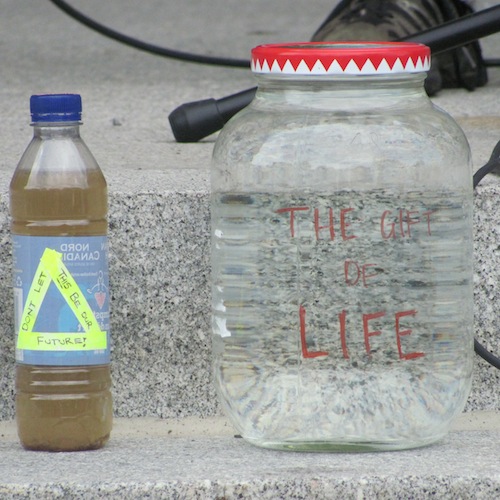
 It is clear that the arguments for safely developing shale gas are being contradicted.
Government statements that New Brunswick has experienced no problems during its drilling history are disputed by the recent news that a drilling accident in Stoney Creek, near Moncton, may have contaminated groundwater.
Of course, folks in Penobsquis, near Sussex, have challenged those statements for years, as they believe that gas drilling was complicit in the loss of their water wells. Penobsquis also experienced extreme losses in property values, a fate that Stoney Creek wants the government to help it avoid.
Another similarity exists between Penobsquis and Stoney Creek. Penobsquis citizens were left on their own to fight multi-billion dollar corporations. In Stoney Creek, the government offered nothing more than the sage advice to “not drink” the contaminated water. This calls into question the regulatory process from beginning to end.
Did the drillers know they were near an aquifer? Was it mapped? Was there an environmental impact assessment? Why did the government not know about the accident? Why was there no investigation or assistance in getting compensation?
Unfortunately, this mirrors the history of enforcement of environmental laws in the province. Yet we are told that if shale gas arrives, with hundreds of wells being drilled annually, that our regulatory system will ensure public safety — no details yet on how that will work. The truth is that no regulatory system has rendered shale gas safe.
Recent findings from beyond New Brunswick question even the most basic argument for shale gas safety, namely that wells are so deep that they cannot affect aquifers, and that the toxic wastewater left in the ground cannot come to the surface.
The same arguments have been made for deep injection wells, which are structurally the same as gas wells, with the notable exceptions that they are even deeper and supposedly safer, since they are designed to hold waste materials for millennia.
But a recent survey of U.S. inspection statistics (by ProPublica) found that from 2007 to 2010, one in every six deep injection wells had a well integrity violation. More than 7,000 showed signs of leaking, some to the surface or to aquifers.
A Pennsylvania study unrelated to shale gas reported that brine solutions found deep in the earth made their way up to aquifers, meaning that fracking fluids could follow similar pathways. A new computer modeling study concluded that fracking fluids could come back to the surface in just a few years.
Also in Pennsylvania, a methane plume traveled miles from its source and into the atmosphere, apparently through natural fractures, with grave implications for public health and climate change.
There are hundreds of old wells around Stoney Creek, some perilously close to Moncton’s water supply. Industry acknowledges that abandoned wells can provide contamination pathways from new wells to aquifers. In conjunction with the above research, this alone should justify a drilling moratorium in Stoney Creek.
We don’t know if Stoney Creek residents’ health problems are from water contamination. But we do know that the only long-term health study, by the University of Colorado, found a 66 per cent increase in the risk of developing cancer and other diseases for those living within one half mile of a gas well’s air pollution.
Note that New Brunswick’s proposed “toughest” regulations allow wells 250 metres from houses and 500 metres from schools.
As these recent studies illustrate, the list of shale gas problems that require vigilant oversight continues to grow. Industry is dealing with the bad news with a multi-million dollar happy-talk media campaign. How will our government react — both to the current incident, and the mounting evidence that shale gas cannot be done safely?
We hope it will do better for Stoney Creek than it has for Penobsquis. In light of the government’s inability to adequately regulate the current handful of wells, it should face the reality that regulating a vast, complex shale gas industry is impossible.
Jim Emberger is a retired software developer, environmental educator and former investigator for the U.S. Federal Energy Administration. He lives in Taymouth.


