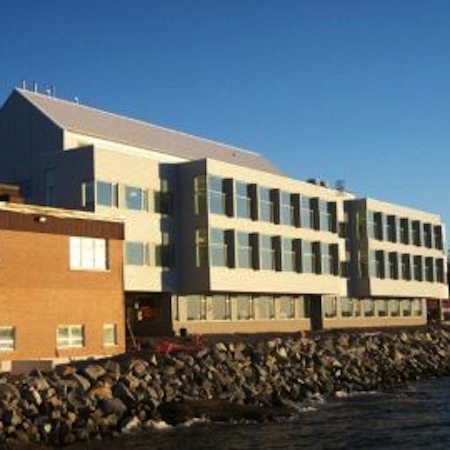
I AM OUTRAGED. It started with a tour of the new St. Andrews Biological Station facility. We, that is, the people of Canada, have invested $71 million and the results are pretty impressive. But there’s a dark downside: while we’ve got a new building, we’re losing key people—and a hundred-year-old science legacy.
The tour ended with a real ending: in the library. It’s a wonderfully spacious room, long and climate controlled, filled with natural light from skylights high above, and banks of rolling bookcases, each at a cost of $15,000 or so, and filled with a collection of science books and research that dates back to the origins of the station (the first of it’s kind in Canada, founded at the turn of the last century). As I said, impressive.
There, we were told that the two full-time librarian positions were being terminated, as is a project to digitize the entire library, and the collection is to be packed off to a central library in Dartmouth at the Bedford Institute of Oceanography. The boxing and shipping alone seemed to be a massive job, not to mention that a great deal of the material is archivally-sensitive and in many cases rare. Some documents are original documents and irreplaceable.
Great Canadian ocean science pioneers such as A.G. Huntsman, Alfred Needler and Bev Scott (now in his 90s) would be horrified. While I can’t speak for Huntsman and Needler, Scott was recently quoted on the Department of Fisheries and Oceans (DFO) website.
“Overfishing is a problem created by governments,” Scott declared, and advised the federal government to limit access to fish stocks to “reduce pressure on fisheries to produce more protein.” And on climate change went on to say, “By the next century, the sea will be two feet or more higher than it is now… New Orleans shows what can happen… Most intriguing is why so many people seem to be ignoring it—especially politicians.”
But the current federal government under Harper is doing the exactly that. And more. Not only is it ignoring the situation, under the new omnibus finance bill C-38 it’s actively gutting both the Fisheries Act and environmental protection legislation as I write this.
Lawrence Macauley, Fisheries and Oceans critic for the Liberal Party writes, “changes to the federal Fisheries Act include: severely weakening federal protection of fish habitat; downloading federal responsibilities to the provinces or third parties; allowing the deposit of deleterious substances authorized by the minister; allowing fish to be killed by means other than fishing when authorized by the minister; allowing the minister to decide which fish will be protected and which will not; giving cabinet the power to exempt any Canadian fisheries waters from the environmental provisions of the Fisheries Act; and allowing the minister to take fish quota and equipment away from fishers and use it to fund scientific activities, all while the minister guts the Department of Fisheries and Oceans’ (DFO) science and habitat management by millions of dollars.”
Add this to the actions of the provinces, like BC’s current (and obscenely perverse) legislation to make it a crime for journalists and scientists to report diseases in farmed fish populations—ostensibly to protect the aquaculture industry from public criticism, and one has to wonder what is happening to our democratic governments. Are they working for us, or for the anti-environmental corporations? The question is rhetorical, of course. We already know the answer.
But back to the local biological station. What do these changes mean for the scientists there, or for us? In a word, confusion. For example, a lot of the new infrastructure was designed to support aquaculture research. But the government has shifted its focus from developing new fish farming techniques to climate change. So the new equipment has to be repurposed, just weeks after the new facility opened.
It’s all too apparent that this federal government has no ocean science and environmental strategy beyond slashing it back. This becomes painfully obvious on the business front, too. Plans are in the works to move 60 DFO finance jobs to New Brunswick, but not to the St. Andrews site. Word has it that the jobs may go to Fredericton to the current Minister of Fisheries and Oceans riding, instead.
So rather than enhancing the existing marine-science economy in St. Andrews, the government is simply rearranging the deck chairs on the Titanic while the DFO itself sinks. Nothing about these moves makes any sense—unless one is adhering to a “government is business” ideology. While that may be good for business it does nothing whatsoever to protect either us or our environment—which was why the biological station was built in the first place, then rebuilt last year.
But one has to wonder, where are all those politicians who made the initial announcements or showed up to cut the ribbons on these new facilities? Where’s the local outrage about these changes? Where’s the desire to not only make our communities healthier, but our economies and environments, too?
It’s time, ladies and gentlemen, if you’re still breathing, to make your voices heard. If you actually dare to care.
This article was originally published in the St. Croix Courier and archived on Gerald McEachern’s blog, The Edge Columns.
![Young Artists Spotlight: Artist Futong Kang [video]](https://newnbmedia.mydev.ca/wp-content/uploads/2021/02/Young-Artists-Spotlight-Kang-350x250.png)

![Tertulia – Mary McCarthy-Brandt on New Brunswick’s first Black lawyer Abraham Beverley Walker [video]](https://newnbmedia.mydev.ca/wp-content/uploads/2021/02/Mary-McCarthy-Brandt-350x250.png)