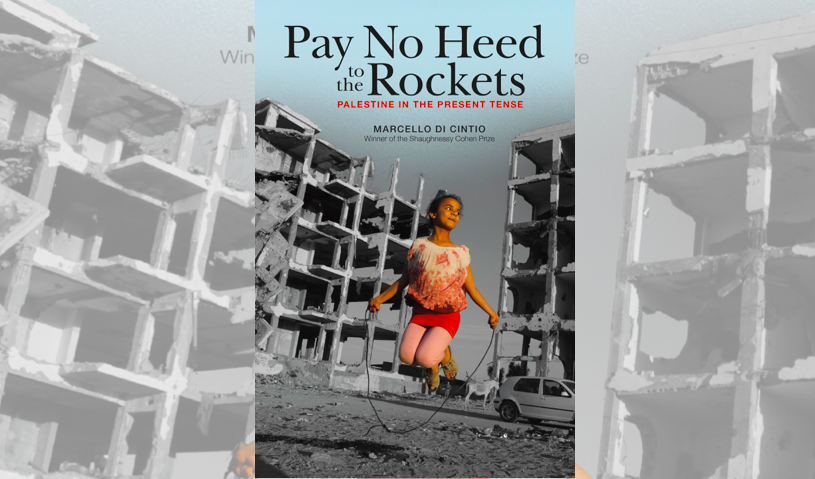
As the United States implodes over the arguments about a border wall, the Palestinians have been living in the shadow of a wall for nearly twenty years. The system of physical barriers around Palestine has become a symbol of an enduring conflict. But the walls don’t represent the rich, contemporary culture of the Palestinians themselves. Those are the stories I sought out in Pay No Heed to the Rockets. — Marcello Di Cintio, January 2019
My map of Palestine is a mess of barriers and forbidden space. A pox of red X’s denote military checkpoints. Red lines indicating Israel’s “separation barrier” lacerate the edges of Palestine’s border and slash inwards to embrace the blue blotches of Israeli settlements. Purple tangles show where stretches of new walls will rise.
Israel started its wall project in the fall of 2002, during the bloodiest days of the Second Intifada. More than six hundred and fifty Israeli civilians had been killed by suicide attacks since the outbreak of violence in 2000. Palestinian terrorists blew themselves up in restaurants, cafés, and buses. The checkpoints and military incursions into the West Bank were not working, and the terrified Israeli populace demanded a different response from their government. Israel began to erect a seven-hundred-kilometre-long system of security barriers around the West Bank. For most of its route the barrier is a three-metre-high fence equipped with barbed wire, electronic sensors, and night-vision cameras. Smooth strips of sand next to the fence reveal the footprints of anyone who makes it over. Red signs in Hebrew, Arabic, and English threaten “mortal danger” and warn “any person who passes or damages the fence endangers his life.”
Alongside the larger Palestinian centres, the barrier is more wall than fence. Great grey slabs of concrete rise out of the ground, bound so tightly together not even a thread of sunlight can infiltrate. Floodlights and security cameras mark the length on top of the wall, and cylindrical watchtowers pose like vertical cannons along the route. I’d passed through the wall’s checkpoint dozens of times, but I was always struck by the barrier’s concrete brashness, its proud rejection of nuance and grace.
Only a tenth of the wall follows the Green Line, the armistice boundary drawn in 1949 and the internationally accepted border between Israel and the West Bank. Most of the barrier creeps east of the Green Line and inside Palestinian territory. In some areas, the barrier plunges deep into the West Bank, swinging wide around Jewish settlements in order to keep them, and much of the land surrounding them, on the Israeli side. The barrier also divides Palestinian villages from both their farmland and neighbouring towns, and annexes a tenth of Palestinian land in the West Bank to Israel.
The International Court of Justice declared the wall illegal, and while proponents claim the barrier saves lives, officials in Israel’s own intelligence agency concede the barrier does not play a major role in reducing terrorist attacks. If the wall can be admired at all, it must be for its audacity.
As soon as the wall rose, artists from around the world came to the West Bank to use it as a canvas. Graffiti art covers the grey concrete throughout the West Bank but most famously in Bethlehem, where ironic murals by reclusive graffiti artist Banksy are a boon to local taxi drivers who offer “Banksy tours” to visitors. In 2017, Banksy opened the Walled-Off Hotel in Bethlehem, which includes a shop — called Wall Mart — that rents ladders, sells spray paint, and offers stencil tutorials. “Your one-stop shop for decorating the wall,” the website declares. Most of the Palestinians I spoke to, however, despise the decorations. They feel the art lends permanence to a structure they hope will one day come down. More than this, though, they don’t want anyone to make the wall beautiful.
Excerpted from Pay No Heed to the Rockets: Palestine in the Present Tense copyright © 2018 by Marcello Di Cintio. Reprinted with permission of Goose Lane Editions.
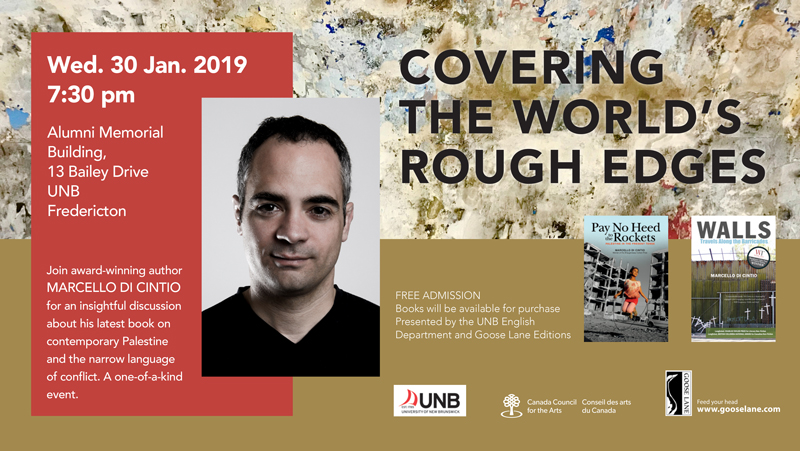
Catch Marcello Di Cintio in Fredericton on January 30th and Saint John on January 31st.